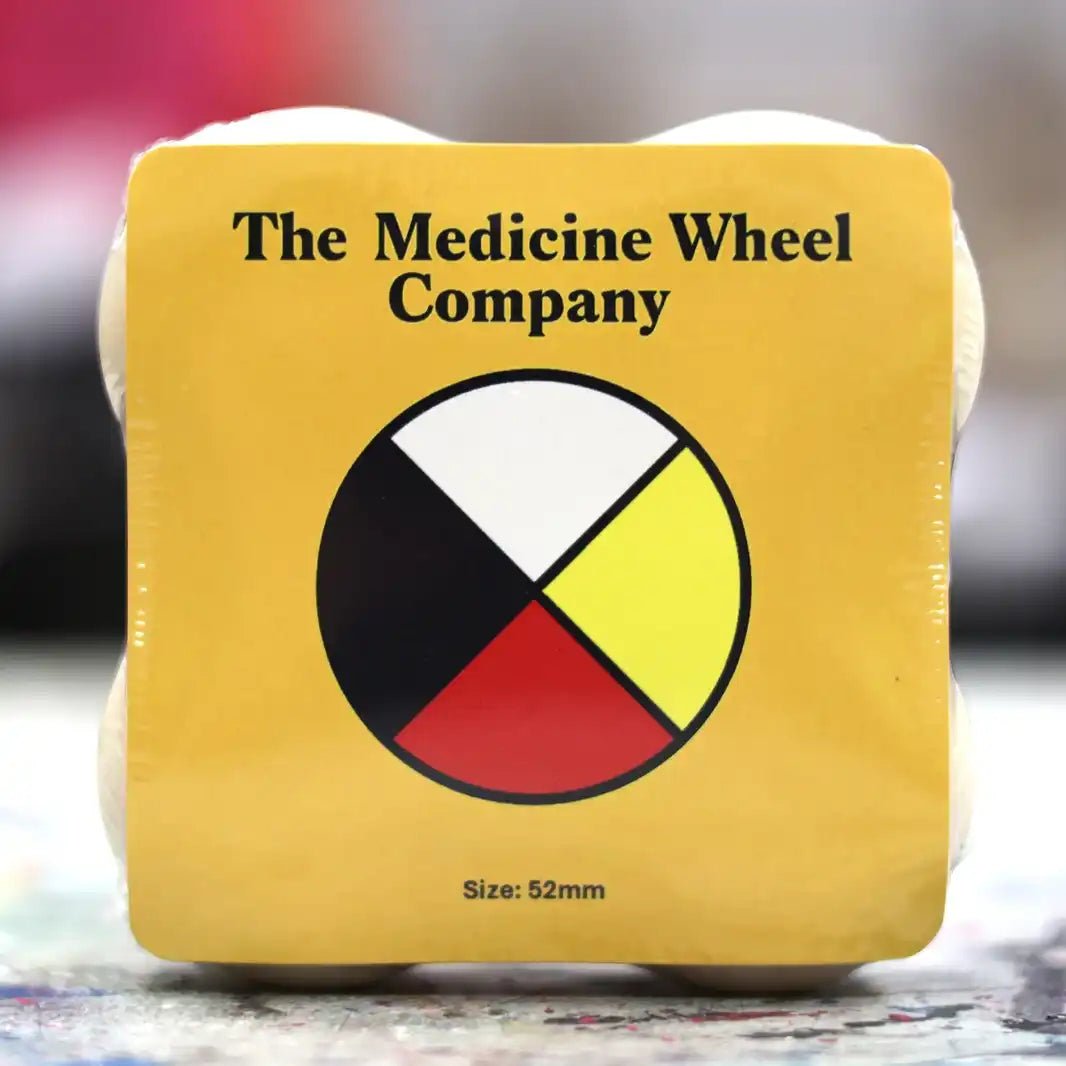


Colonialism Medicine Wheel Company Wheels (54mm)
Colonialism Medicine Wheel Company Wheels (54mm)
Couldn't load pickup availability
Colonialism Medicine Wheel Company Wheels. Sold as a set of four.
Imported.
The Medicine Wheel Teachings & Skateboarding as Healing
The Medicine Wheel teaches us that healing is holistic by touching the physical, mental, emotional, and spiritual aspects of life. Skateboarding, too, can be medicine. It builds strength within us, clears the mind, lifts the heart, and connects us to our body, mind, and the land.
The Medicine Wheel teachings differ from nation to nation. Some have four directions; some communities have six or more, and colours vary as well, according to the traditional teachings of the hundreds of nations across Turtle Island. Some nations have a 3-D Medicine Wheel with a center circle, which often represents the self or the child. This central point is sometimes connected with the individual’s own journey or inner being. In some teachings, it specifically symbolizes the child, highlighting the importance of personal growth, kinship, and connection within the Medicine Wheel’s teachings.
Examples of colors and directions:
Yellow - East
• Represents new beginnings, childhood, and the element of air.
Red - South
• Represents youth, passion, and the element of fire.
Black - West
• Represents adulthood, introspection, and the element of water.
White - North
• Represents elderhood, wisdom, and the element of earth.
The Medicine Wheel is not a single, uniform system; it’s a living teaching that changes by nation, community, and Elder. For example, in many Lakota sources, the wheel commonly appears with Yellow (East), Red (South), Black (West), and White (North), and ties each direction to seasons, life stages, animals, and elements. The Aktá Lakota Museum and Lakota teachers describe these associations in detail. The Anishinaabe/Ojibwe often use yellow, red, black, and white as well, but frequently include seven directions and attach different teachings, medicines, and stages of life to those directions.
People need to stop generalizing a “one-size-fits-all” model, which erases nation-specific authority and protocols. Indigenous peoples and scholars note that pan‑Indian or mass‑market medicine wheel models have mixed different teachings and created confusion. To be respectful and want authentic Indigenous practice and language about colours, directions, and ceremonies, consult community Knowledge Keepers or Elders from the specific nation you’re referencing.
**If you have any more education attached to the Medicine Wheel, please contact me **
Chi Mikwec,
Aho,
References
Aktá Lakota Museum & Cultural Center. Lakota Medicine Wheel: Sacred Circle of Life. Aktá Lakota Museum.
Four Directions Teachings. Ojibwe Teaching. Fourdirectionsteachings.com.
Medicine wheel (symbol). Wikipedia.
Nabigon, J., et al. (2014). Medicine Wheel Teachings – Historical and Contemporary Realities: Movement Towards Reconciliation. Open Library Publishing Platform.
Michael Langan is an Indigenous artist from Cote First Nation, Treaty 4 Territory, who is committed to educating people through creative renderings of our colonial past. After moving to Regina almost 20 years ago, Micheal immersed himself in the local skateboard community, of which he has remained a prominent member ever since. Last spring, Micheal launched his own skateboard company – Colonialism Skateboards – to draw attention to, and have people engage with, complex and untelling aspects of Indigenous Canadian history and culture. By combining skateboard art with a history lesson on Indigenous culture and colonialism in Canada, Micheal’s innovative approach is leading a conversation about how Canadians, especially youth, can move forward together through reconciliation.
Profoundly influenced by his upbringing and experiences as an inter-generational residential school survivor, Micheal’s initiative has grown and expanded beyond the realm of skateboarding. He has been invited to elementary and high school classrooms in Regina, Fort Qu’Appelle, as well as various community panels to speak about his company and its mandate. He was recently invited to the Winnipeg Art Gallery to speak on an Indigenous artist panel, where his boards were featured.
Colonialism Skateboards continues to receive international attention as Micheal inspires skateboarders and non-skateboarders alike to learn about the history and enduring legacy of colonization, and to think about ways to address these ongoing challenges locally and globally.
Colonialism has produced several pro boards for Joe Buffalo as well as a guest board with Dustin Henry.
Micheal has been a long time member of the Tiki Room family.
SKU:MWC002
Share