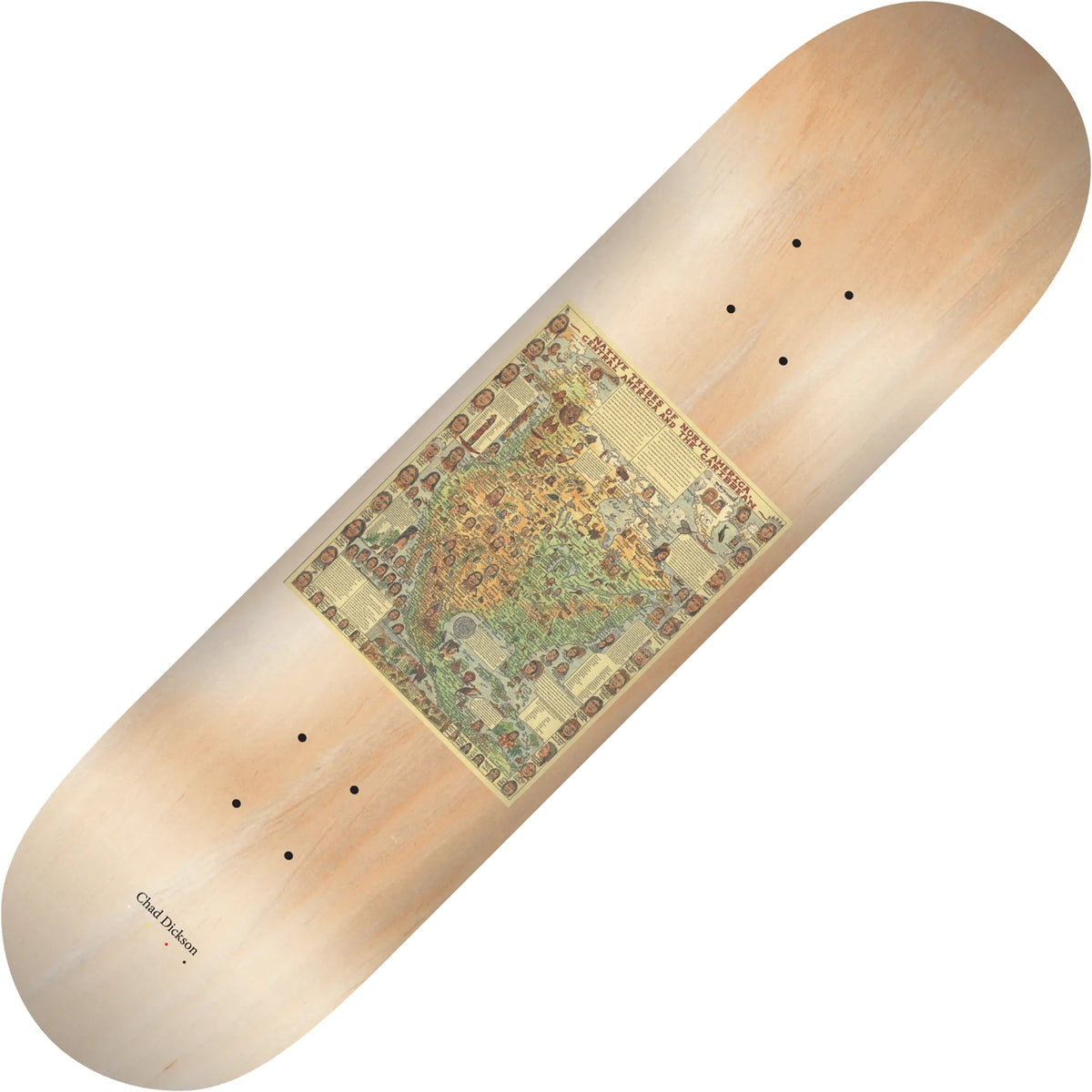

Colonialism Chad Dickson Tribes Deck (8.625")
Colonialism Chad Dickson Tribes Deck (8.625")
Couldn't load pickup availability
Colonialism Chad Dickson Tribes Deck (8.625"). Stain Colour may vary. If stain colour is a concern, please contact us before ordering. Boards cannot be returned due to stain colour being different than shown. Grip not included, but can be purchased in our grip and hardware section.
Imported.
For the next graphic, Colonialism looks at the history surrounding the earliest forms of colonial enforcement beginning when European empires first arrived on Indigenous lands and built systems of control that restricted movement, removed people from their homelands, and justified violence through racialized narratives. This history stretches back to first contact, when Europeans began imposing structures that still shape the present. Long before ICE, long before borders, long before the idea of “illegal” people, colonial governments were already deciding who belonged and who didn’t. Historians such as Andrés Reséndez (2016) have shown that Indigenous enslavement and policing were not side stories but central pillars of colonization across North America, Mexico, and the Caribbean, early enforcement systems designed to control land, bodies, and movement.
Indigenous nations across Turtle Island welcomed newcomers with protocols of visiting, trade, kinship, and diplomacy. Indigenous scholars have documented how movement across the continent was relational, unrestricted, and grounded in responsibilities to land and community (Simpson, 2017; Alfred, 2009; Anderson, 2011). Europeans did not enter an empty land; they entered a hemisphere full of sovereign nations with their own laws, governance, traditions, and teachings.
Meanwhile, European powers were already creating hierarchies of belonging among themselves. British colonial officials frequently described incoming Irish migrants as dangerous, undesirable, or “unfit,” using fear-based rhetoric to justify exclusion and control (Kenny, 2014). Spanish colonial administrations used similar narratives to manage movement and maintain power in their territories (Reséndez, 2016). These early patterns of racialized migration control laid the groundwork for the enforcement systems that would later emerge in Turtle Island (North America).
Modern journalism has documented how these colonial logics continue today. Reporting from The Guardian, Reuters, The New York Times, and the Associated Press has shown how ICE’s detention practices, raids, and family separations disproportionately impact migrant and Indigenous descendant communities, especially in regions where ancestral homelands cross the U.S. and Mexico border (Davis, 2018; Dickerson, 2019; Associated Press, 2020; Reuters, 2021).
How can people be “illegal” on stolen land, and on lands their ancestors have lived on since time immemorial? Indigenous scholars have long argued that the concept of “illegal” people is a colonial invention. It’s a tool used to control land, restrict movement, and justify violence (Coulthard, 2014; Simpson, 2017; Alfred, 2009). Many communities targeted by modern enforcement systems have ancestral ties to these lands that go back thousands of years. The border itself is a colonial line drawn across Indigenous homelands, dividing families, nations, and trade routes (Grande, 2015). This graphic speaks to that truth. It connects the long history of colonial enforcement from pass systems and residential schools to modern immigration policing. It’s a reminder that Indigenous peoples have always been here, and will always be here.
This artwork/map was created by Michael McArdle Nakoma, an Anishinaabe-Lakota artist whose work focuses on cultural education and Indigenous history. The map shown here is a visual representation of the many Indigenous Nations across Turtle Island - North America, Central America, and the Caribbean. It’s meant to help viewers understand the vastness and diversity of Indigenous communities throughout the continent. As with many historical maps, there may be inaccuracies or omissions, so viewers should keep that in mind when learning from it.
Aho Shamay!
References
Alfred, T. (2009). Wasáse: Indigenous pathways of action and freedom. University of Toronto Press.
Anderson, K. (2011). Life stages and Native women: Memory, teachings, and story medicine. University of Manitoba Press.
Associated Press. (2020). US immigration agency criticized for treatment of detainees. Associated Press News.
Coulthard, G. S. (2014). Red skin, white masks: Rejecting the colonial politics of recognition. University of Minnesota Press.
David Rumsey Map Center. (n.d.). Native Tribes of North America, Central America and the Caribbean [Map]. David Rumsey Map Collection. https:// ww w.davidrumsey.com/luna/servlet/detail/RUMSEY~8~1~273022~90046772
Davis, A. (2018). ICE’s actions raise concerns about racial profiling and migrant rights. The Guardian.
Dickerson, C. (2019). The impact of family separation on migrant communities. The New York Times.
Grande, S. (2015). Red pedagogy: Native American social and political thought (10th anniversary ed.). Rowman & Littlefield.
Kenny, K. (2014). The Irish in the Atlantic world. Cambridge University Press.
Reuters. (2021). US immigration enforcement faces scrutiny over detention conditions. Reuters.
Reséndez, A. (2016). The other slavery: The uncovered story of Indian enslavement in America. Houghton Mifflin Harcourt.
Simpson, L. B. (2017). As we have always done: Indigenous freedom through radical resistance. University of Minnesota Press.
Michael Langan is an Indigenous artist from Cote First Nation, Treaty 4 Territory, who is committed to educating people through creative renderings of our colonial past. After moving to Regina almost 20 years ago, Micheal immersed himself in the local skateboard community, of which he has remained a prominent member ever since. Last spring, Micheal launched his own skateboard company – Colonialism Skateboards – to draw attention to, and have people engage with, complex and untelling aspects of Indigenous Canadian history and culture. By combining skateboard art with a history lesson on Indigenous culture and colonialism in Canada, Micheal’s innovative approach is leading a conversation about how Canadians, especially youth, can move forward together through reconciliation.
Profoundly influenced by his upbringing and experiences as an inter-generational residential school survivor, Micheal’s initiative has grown and expanded beyond the realm of skateboarding. He has been invited to elementary and high school classrooms in Regina, Fort Qu’Appelle, as well as various community panels to speak about his company and its mandate. He was recently invited to the Winnipeg Art Gallery to speak on an Indigenous artist panel, where his boards were featured.
Colonialism Skateboards continues to receive international attention as Micheal inspires skateboarders and non-skateboarders alike to learn about the history and enduring legacy of colonization, and to think about ways to address these ongoing challenges locally and globally.
Colonialism has produced several pro boards for Joe Buffalo as well as a guest board with Dustin Henry.
Micheal has been a long time member of the Tiki Room family.
SKU:CS081926.06
Share